
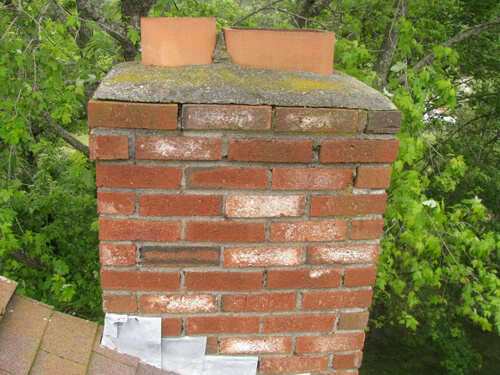
This article is not directed at anyone or any company just at the process and in the name of doing quality work.
Being in the chimney business for over 20 years has allowed me to witness all kinds of installations and repairs. As in any construction there are right ways to do things and there are shortcuts which some choose to take.
What has been brought to my attention is the improper use of poured insulation around stainless steel liners.
From my experience, correctly installing insulation mix around stainless steel liners (to get a zero clearance rating) is a next to impossible. Besides the fact that this installation is widely and incorrectly used, manufactures seem to be pushing installers towards this method.
In the December, 2011 Issue of The Chimney Sweep News there is a 5 page article on “Copperfield’s relining workshop”. Russ Dimmitt states, “I lean more and more toward poured insulations,” (meaning poured mix around stainless liners).
The Copperfield pro book states that “HomeSavers Insulation Mix” and “TherMix” are “the consistency of damp potting soil. The same consistency is common with other manufactures like “Best Mix” from New England Chimney Supply, “Everguard” from Olympia and “Premier Mix” from National. Upon Reading the Installation instructions it is stated that a minimum of 1’’ of mix is required around the entire liner to obtain the zero clearance rating.
When installing a liner using this mix, how do you center the liner in the chimney and ensure that the mix is all the way around the liner and has one inch in thickness?
Let’s say, for example, that we are lining a basic 8’’x12’’/ 16’’x21’’ block chimney and we have removed the tile liner after a chimney fire.
There is wood touching the chimney (commonly found in homes) so we need to use zero clearance insulation around the liner. The stove is 7’’ and the height is over 25’. Let’s say that the chimney is completely plumb (a rarity). The inside dimensions are 9’’x 12’’ after the tiles are removed. The outside dimensions of a 7’’ liner are 7.25’’ this leaves less than one inch on either side of the short ends of the block (already not to code, but close so we will continue).
Now we need to take into account the fact that when the chimney was built there were mortar joints left between the blocks (it would take countless hours to remove these joints and it is hard to believe that any installers do) these mortar joints can easily protrude out into the opening anywhere from 1/8’’ to ½’’ .
I have poured “cast in place” liners for over 15 years. In a “cast in place” liner pour, you use a mix that is a self-leveling slurry and even with this liquid mix you need a vibrator and centering springs on the liner to ensure that the mix has been centered all the way around the former. (We now install stainless steel liners; we are not pushing for cast in place liners.)
It is impossible to center a stainless steel liner even in a completely straight chimney. There are no centering devices sold with this poured insulation by any manufacturer. Why is this? Because even if you used springs to center this liner the “damp potting soil” consistency of the mix would not flow consistently, if at all, around the liner.
When asking multiple installers and dealers about how to center a stainless steel liner when pouring this mix and how they know the insulation has made it all the way around the liner, the best answers that I have been given are “well, you pull up on the liner and that centers the mix” and “you just know.”
So far we have discussed a chimney that has been completely straight. What if a chimney has a bend? What do you do if a common 8’’x8’’ brick chimney varies in size? What if the blocks are offset a ½”? Most installers would say “close enough”!
Another Issue with using this mix is that the removal of a damaged liner with poured insulation around it is a nightmare. The mix jams up on itself as you pull up on the liner. I have removed 5 separate liners and each time I had to uncoil the light wall liner to remove it. What if the mix is poured around a “heavy-wall” liner?
As stated by Russ, “in a tight space, the liner can go down without insulation and then you can pour insulation in” (Pg 10, Chimney Sweep News). This statement seems more of a sales pitch then a teacher instructing the correct way to do things. I can only hope that this statement was made about code complying relines, where the liner didn’t require insulation but it was an extra to do so.
In the same Chimney Sweep News issue, Genevieve Bures states that “In only 30% of the confirmed chimney fire cases I investigated and later reviewed proposed repairs on, have I found that the proposed repairs meet the minimum fire code replacements” (Pg 14 Chimney Sweep News). How many of these are improperly poured insulation around stainless steel liners?
It is disturbing to see the leading manufacturers pushing a product that cannot be installed correctly. This mix is an easy way for “fly by nighters” and amateur Installers/sweeps to take the easy way out and make a quick buck off of homeowners by doing things the wrong way.
I hope that this article can sway sweeps, installers and manufacturers away from poured insulation (around stainless steel liners) and steer them towards quality Insulation techniques like ½ in foil faced Insulated blankets or snap wraps which give you a zero clearance rating.
~ Chimney Savers Inc.
7 thoughts on “A Listed Chimney Liner Insulation That Doesn’t Work!”
These questions have a lot of variables.
The first question is ‘does it need insulation?’. The answer varies based on what fuel the liner vents and the location of the chimney.
If the liner is for a wood or coal burning appliance then the answer is always YES. If there was a chimney fire or the scan shows cracks or open joints the flue tiles should always be removed. I have seen many chimneys that had creosote on the outside of the tiles.
Wood and coal insert liners need to be insulated down past the damper frame. I’ve seen houses burn because the insulation stopped in the smoke chamber and overheated the wall in that area.
Mark Jones
Chestnut Hill Chimney & Hearth
Farmington, New Hampshire
(603) 755-4835
http://www.chestnuthillchimney.com
Owner, Head Instructor
Chestnut Hill Chimney & Hearth Training Center
NFI Certified Master Hearth Professional
National Association of Fire Investigators
For oil and gas the answer is maybe. There is normally no overriding requirement for insulation.
A high efficiency appliance will have comparatively low exhaust temperatures and so insulation will always help with the draft, reduce condensation and extend the life of the liner. An exterior chimney will benefit from liner insulation especially in cold climates.
With a very high efficiency appliance insulation really should be considered necessary, even more so with exterior chimneys and cold climates, but is usually not required.
Liners going through a very large space should be insulated. You can get a convection loop in the space between the liner and the masonry shell that will cool the liner.
Mark Jones
Chestnut Hill Chimney & Hearth
Farmington, New Hampshire
(603) 755-4835
http://www.chestnuthillchimney.com
Owner, Head Instructor
Chestnut Hill Chimney & Hearth Training Center
NFI Certified Master Hearth Professional
National Association of Fire Investigators
For any liner if the flue tiles are badly damaged or deteriorated they should be removed to prevent them from collapsing in the future and crushing the liner. This may create the large space mentioned above.
Now for the confusing part. The NFPA 31 oil code says to check the liner for condensation after the appliance has been run for a period of time. If there is condensation after the liner is up to temperature then it should have been insulated or it is incorrectly sized. Unfortunately after the liner is in place it’s kind of hard to insulate it properly.
You really need to deal with someone who understands these variables as they apply to your climate.
Mark Jones
Chestnut Hill Chimney & Hearth
Farmington, New Hampshire
(603) 755-4835
http://www.chestnuthillchimney.com
Owner, Head Instructor
Chestnut Hill Chimney & Hearth Training Center
NFI Certified Master Hearth Professional
National Association of Fire Investigators
In my climate, middle New Hampshire, I always recommend insulation for exterior chimney, high efficiency appliances. I also explain to the customer that if the liner fails due to corrosion, even if the liner manufacturer warranties it, which they don’t have to, the customer still pays for the labor to replace it.
As to the type of insulation I always use either a wrap/blanket type or a pre-insulated liner. I prefer to use rigid liner for wood or coal when possible and that gets a wrap insulation. For wood/coal in a chimney with an offset I only use heavy wall flex liners with field wrapped blanket insulation.
For oil or gas I use the pre insulated liners when needed.
Mark Jones
Chestnut Hill Chimney & Hearth
Farmington, New Hampshire
(603) 755-4835
http://www.chestnuthillchimney.com
Owner, Head Instructor
Chestnut Hill Chimney & Hearth Training Center
NFI Certified Master Hearth Professional
National Association of Fire Investigators
I do a lot of chimney/hearth product fire investigation work and so end up taking apart chimneys that have burned down houses. Having taken down many chimneys and removed many liners with poured insulation in my 32 years in the trade, I will not use poured insulation around liners.
Chimneys with poured insulation need to have special attention paid to keeping water out of them in cold climates. The insulation will retain any water that gets in for much longer and increase the freeze/thaw damage to the masonry.
Remember, some day that liner will fail or need to be removed due to a change of use. Removing liners with poured insulation is usually complicated and expensive.
Mark Jones
Chestnut Hill Chimney & Hearth
Farmington, New Hampshire
(603) 755-4835
http://www.chestnuthillchimney.com
Owner, Head Instructor
Chestnut Hill Chimney & Hearth Training Center
NFI Certified Master Hearth Professional
National Association of Fire Investigators
And as for the last question, ‘how do you know if it’s insulated the entire length?’. With poured liners mixed correctly no one knows including the installer. I’ve taken down chimneys with poured insulation and found big spaces with no insulation as well as areas where the liner was contacting the masonry shell with no insulation between.
With wrapped or blanket insulation you have to either see the insulated liner before or as it’s installed or trust your installer.
Mark Jones
Chestnut Hill Chimney & Hearth
Farmington, New Hampshire
(603) 755-4835
http://www.chestnuthillchimney.com
Owner, Head Instructor
Chestnut Hill Chimney & Hearth Training Center
NFI Certified Master Hearth Professional
National Association of Fire Investigators
There are very small, 1/4”diameter x up to 50’ long, sewer inspection cameras that can fit down the corners of the space around the liner that should be able to show the outside of the liner but they aren’t normally used in the chimney business.
If you have an exterior chimney a thermal imaging camera may show warmer areas that aren’t insulated but that’s harder to do with low exhaust temperature appliances.
Mark Jones
Chestnut Hill Chimney & Hearth
Farmington, New Hampshire
(603) 755-4835
http://www.chestnuthillchimney.com
Owner, Head Instructor
Chestnut Hill Chimney & Hearth Training Center
NFI Certified Master Hearth Professional
National Association of Fire Investigators