
Constant fireplace smoking is the topic of this article.
It is one of the most valued features in our homes. And all too often, the fireplace is labeled “non-working” and sits unused, because the homeowner doesn’t know what to do about a smoking problem. Here I will show how most smoking problems can be handled relatively easily, with little or no expense. We’ll cover:
- Smoky fireplace startups
- Smoky fireplace endings
- Constant fireplace smoking
- Smoking fireplace on windy days
- Smoking fireplace on damp or rainy days
- Smoking from fireplace in other rooms
Here’s a trick for monitoring smoky fireplaces: If you can’t see the smoke spilling from the fireplace, shine a flashlight across the fireplace opening. The light reflecting off the smoke particles will make it easy to see.
Constant fireplace smoking
If the fireplace always smokes, the problem might be:
Fireplace blockage
Sometimes, constant fireplace smoking problem is caused by a partial or complete blockage of the flue.
Depressurized House
Although this problem sometimes only shows up when the fire is burning low, for some super-tight houses it is a constant problem. This is the first possibility to explore if you have a tightly-insulated house, an air exchange system, or exhaust fans in operation. If there is not enough air available in the house to allow the fireplace to draw, it will smoke.
Fireplace Smoke Chamber is too small
The triangular cavity (above the damper) that funnels the smoke up into the flue liner is called the smoke chamber. While an over-sized smoke chamber can lead to difficulty in getting the draft going, if the smoke chamber is too small, constant fireplace smoke sometimes curls out at the top of the fireplace opening and spills into the room. When the fire is out, open the damper and shine a flashlight up into the smoke chamber.
Safety Alert: Wear gloves and eye and ear protection any time you work on your fireplace. Damper edges are sharp, and will cut you. Debris in the flue could get into your eyes and ears, causing injury.
The side walls of the smoke chamber shouldn’t be more than 45 degrees from vertical. Usually, the smoke chamber is about three feet high. If yours is closer to 18 inches, or shorter, it could be the culprit. A smoke guard or fireplace doors might solve the problem.
Fireplace smoke guard
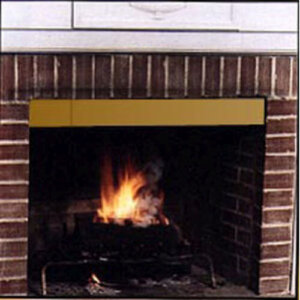 A smoke guard is a piece of non-combustible material (usually steel) placed over the top of the fireplace opening, to lower the opening.
Before you buy one, do this: Take a piece of aluminum foil a little wider than the fireplace opening, and fold it in half width-wise, to make it sturdier. When the fire is going, tape it over the top of the opening, covering a few inches of the opening. (Go easy on the tape! You will want to adjust it). Monitor the fireplace as the fire burns. If it spills smoke, lower the foil; if it doesn’t, raise it. Adjust it until you find out (a) if it works at all, and (b) how much of the opening you need to cover in order to solve the problem.
If your foil smoke-guard works, go out and buy a smoke guard at least as wide as you need.
Fireplace doors
Fireplace doors are generally constructed of tempered glass panels in a metal frame. The frame usually covers a couple of inches of the fireplace opening, so fireplace doors act something like a smoke guard, lowering the effective opening of the fireplace.
And, if the fireplace starts to constantly smoke, you can close the doors. Fireplace doors also save heat, since you can close them before you go to bed, preventing heat loss up the flue. (Remember, you can’t close the damper until the fire is completely out, often a day or more later.)
Fireplace flue is too small
If the flue is too small, it might not be able to handle the volume of airflow needed to draw the smoke up and out.
For the facts & figures buffs
The rule of thumb for flue liner sizing is for the cross- sectional area of the flue to be about one- tenth to one-twelfth the area of the fireplace opening. But other factors, such as overall height, location of the chimney, and chimney construction, also play a role.
Most masonry fireplace flues are lined with 8″ x 12″ terra-cotta tiles. But this is a nominal dimension, and the actual inside dimension is usually closer to 6.5″ x 10.5″.
Calculating the correct flue liner size is pretty complicated. But as a rough-and-ready guess, if you answer yes to all of these questions, an undersized flue might be the problem.
- Is the fireplace opening pretty close to 36″ wide x 28″ tall (or larger)?
- Is the flue liner smaller than an 8″ x 12″ nominal liner?
- Is the house fairly open, or drafty, rather than being tightly insulated? (If it is very tight, consider Depressurized House first.)
- Is the chimney built up the inside of the house? (If it is on the outside, see “Cold Flue by Design” above).
If so, the next step is to hire a chimney professional to examine the entire system. If your chimney professional determines that the flue really is too small, the solution is a smoke guard or fireplace doors. These two devices will reduce the opening size of your fireplace, changing the ratio of the opening size to the flue size, improving the fireplace’s ability to draw all the smoke up and out.
Fireplace damper is too low
Similar to the small smoke chamber problem is the misplaced damper. Normally, there is some room above the top of the fireplace opening for smoke to gather before it moves through the damper and into the smoke chamber. But if the damper is installed right at the top of the fireplace opening, smoke sometimes spills into the room.
This is especially problematic if the damper opening is particularly narrow, or if the damper is installed at a steep angle, acting like a baffle.
A “baffle” is anything that slows or re-directs the flow of smoke and gasses.
The solution to a misplaced damper is either (a) to remove and replace the damper, often a costly and involved proposition, or (b) to install a smoke guard or fireplace doors. Smoke guards and fireplace doors work by lowering the top of the fireplace opening, adding extra space for the smoke as it collects prior to passing through the damper. This solution often helps reduce or eliminate constant fireplace smoking.
- Read Part 1 of Smoking Fireplace – Smoky Fireplace Startups
- Read Part 2 of Smoking Fireplace – Smoky Fireplace Endings
- Read Part 4 of Smoking Fireplace – Smokes on Windy Days
- Read Part 5 of Smoking Fireplace – Smokes on Wet Days
- Read Part 6 of Smoking Fireplace – Smoke Enters Rooms
~ Todd Woofenden
9 thoughts on “Smoking Fireplaces Part 3: Constant Fireplace Smoking”
Do you have 16inch smoke guards
Margaret Hughes: CHIMNEYS.COM is not a chimney sweep company; nor are we manufactures or distributors of chimney products. Please talk with your local chimney sweep who will probably be able to help you.
16″ high or wide?
The standard smoke guard is only 4″ high. Anything more than that would have to be custom made. However, if you need a 16″ high smoke guard, there is likely something very wrong with the design of the chimney.
Standard guards are adjustable for the width but 16″ is pretty narrow. It may be possible to trim one down or you are back to a custom one.
Mark Jones
Chestnut Hill Chimney & Hearth
Farmington, New Hampshire
(603) 755-4835
http://www.chestnuthillchimney.com
Owner, Head Instructor
Chestnut Hill Chimney & Hearth Training Center
NFI Certified Master Hearth Professional
National Association of Fire Investigators
Hi. Significant smoke pours into my living room whenever I light a wood-burning fire, even with the tempered-glass doors shut. The problem is reduced in warm weather (when I don’t need a fire in the fireplace). Apparently, wind blowing down the chimney actually blew a flaming log into the living room for the former owner, causing the house to catch fire. A professional chimney sweep recommended extending the height of the chimney, but it is already up to code/standard height. Would a wind-directional chimney cap be a possible solution?
Without seeing the chimney it is impossible to give a 100% accurate diagnosis, but assuming all else is 100% up to code standards, having a certified chimney sweep work in conjunction with a licensed electrician to install a proper enorvex exhaust fan could be a solution.
You could also install a pellet stove insert which is fan assisted.
In either case, the unit would not be functional if the power went out. Raising the chimney height could be tried instead, but if it is a pressurization issue in the home it may not work and a mechanical exhaust system will most likely be needed.
If it were my home I would install a pellet stove insert.
Edward Hewitt
Anything Chimney – Manchester NH Chimney Sweep
https://anythingchimney.com/
(603) 716-5977
Hi Linda,
You may have several different problems and causes.
Bear in mind that the physics of draft will make a chimney draw better as the outside air temperature is lower and the chimney is taller, (once the chimney flue is warmed up!!).
So, if you have an exterior chimney and you are starting the fire with a cold flue, that can have a smoking problem until the chimney warms up.
Your statement that the problem is reduced in warm weather would suggest this. There are tricks to warm up the flue.
A wind induced back draft is a different problem and usually caused by external conditions such as roof lines, terrain, prevailing winds or trees near the chimney.
Extending the chimney may or may not help. Code height is basically a safety concern not a performance one; so, it is common to go well above code minimums.
Directional caps don’t always work. They won’t work if the cause is pressure as opposed to wind moving across the top of the flue. Sometimes you have to try one to find out.
Mark Jones
Chestnut Hill Chimney & Hearth
Farmington, New Hampshire
(603) 755-4835
http://www.chestnuthillchimney.com
Owner, Head Instructor
Chestnut Hill Chimney & Hearth Training Center
NFI Certified Master Hearth Professional
National Association of Fire Investigators
Hi Linda!
Unfortunately, there’s not enough information here to answer your question.
Draft problems can arise from a variety of issues – from burning practices to flue size to, yes, chimney height.
As regards chimney height, though, the code is “ten and two” – basically, your chimney needs to be two feet taller than anything within ten feet. That said, there are rare occasions where a building has a peak that is farther away than ten feet, is taller than the chimney, and lines up just so with prevailing winds, when a taller chimney becomes necessary.
Your best course of action is to locate a certified chimney tech (the CSIA is a good place to start) and get their opinion.
Good luck!
OHIO Chimney Co
https://www.ohiochimney.com/
admin@ohiochimney.com
(330) 392-0555
Good afternoon, Linda!
If we’re being honest there just isn’t enough information to go on for us to give you any recommendations.
I don’t know what chimney inspection service you used but I would double check that they are certified. If they have the proper certifications then I would go with their advice.
Some certifications are the CSIA (Chimney Safety Institute of America) and the CCP (Certified Chimney Professional).
Something else to check is if the company is a member of the NCSG (National Chimney Sweeps Guild). If the person who came out and gave you the recommendation had some or all of these credentials, I would trust their estimate. If not, it would definitely be worth having a certified inspector come give your situation a more detailed look.
Nick
OHIO Chimney Co
https://www.ohiochimney.com/
nick@ohiochimney.com
(330) 392-0555
The fact that the problem is reduced in warmer weather makes me wonder if:
1: a furnace pulls so much air out of the house that air has to come down the fireplace flue to replace it, or
2: if the furnace uses a forced air system to distribute heat through the house, the return air register in the room where the fireplace is may be pulling air back to the furnace faster than it is recycled, causing negative pressure in the room, thus causing air to come down fireplace flue, or
3: this is a chimney on the exterior wall of your house that is poorly insulated and the cold air drops faster, the colder it is out causing a back draft.
Solutions will require an experienced chimney sweep to solve, but generally all draft issue problems can be solved with the correct sized Enervex Fan, but it is a costly solution.
WILLIAM J PERRON
http://www.chim-chiminey.com/
billjanperron@verizon.net
914-736-1006